
Pricing supplies the possibilities. The borrower’s plan changes the answer.
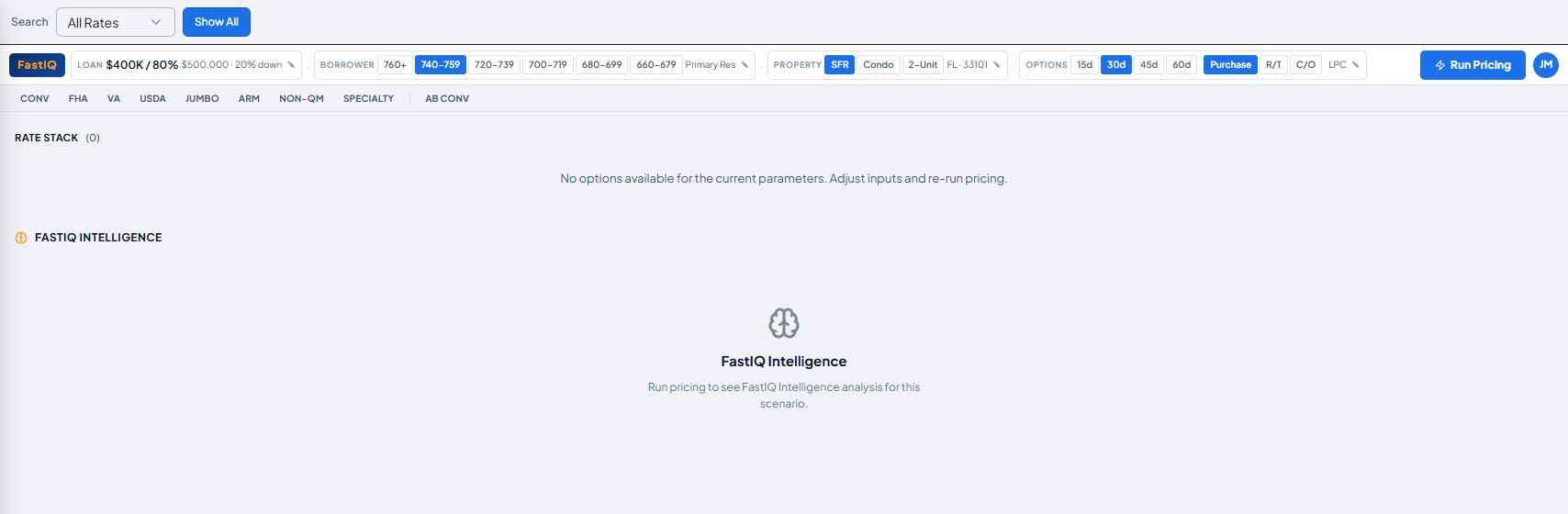
Rate is an input, not the decision. Fast Intelligence turns live lender pricing into a recommendation and a month-by-month financial analysis of cost, mortgage insurance, balance, inflation and equity.
What it is
A borrower-specific decision, not a rate table.
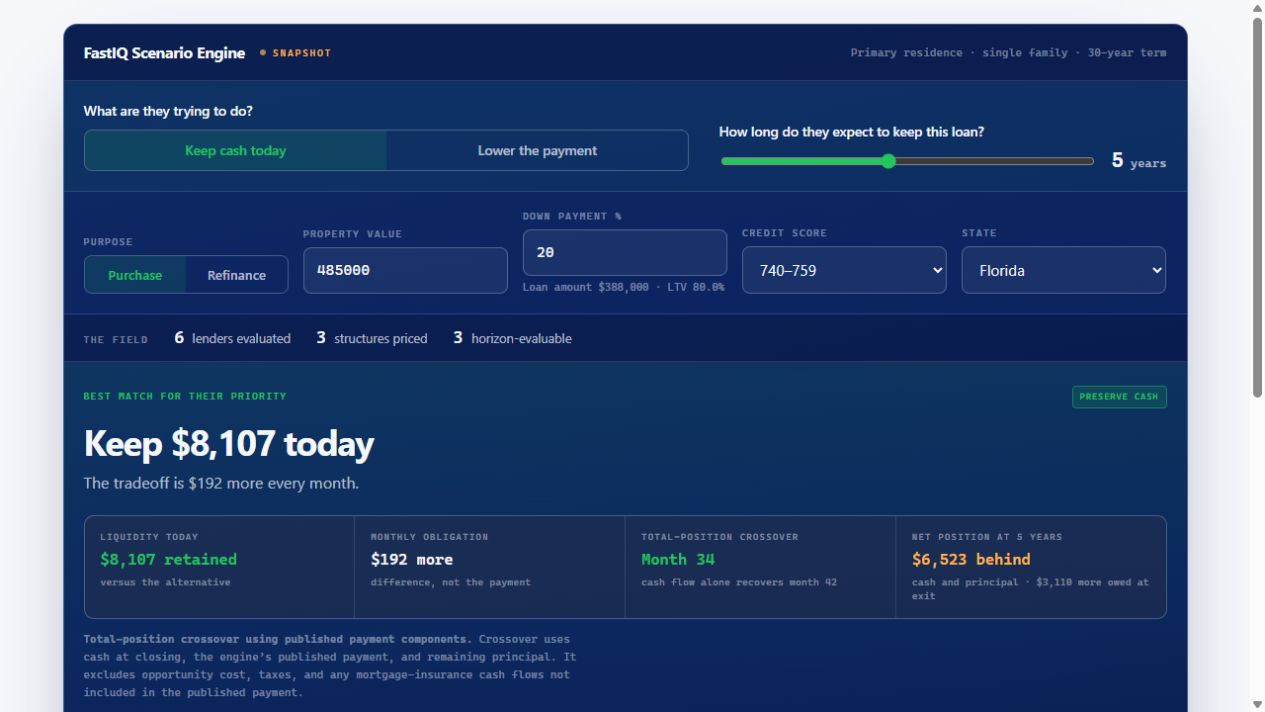
The engine prices every eligible structure across your wholesale connections, then answers a different question: given what this borrower is trying to do and how long they expect to hold the loan, which structure serves that plan — and what does it cost them?
The loan officer supplies two things the sheet cannot know: the borrower’s objective and their horizon. Everything else is computed from live pricing.
Real product
The financial conclusion—not another rate table.
One Fast Intelligence contract now carries the recommendation, mortgage insurance, cost over time, remaining balance, inflation-adjusted view, crossover and estimated exit equity to every screen that presents the analysis.
Captured in controlled FastIQ environments using synthetic, aggregate, placeholder or public demonstration information. Live rates and operational totals change over time.
What it computes
One monthly ledger. The whole financial position.
Liquidity today — what the structure retains or spends at closing
Monthly obligation, stated as the difference rather than the payment
Scheduled mortgage insurance by month, including conventional automatic termination or the verified program duration when determinable
Interest, financing cost and remaining principal at 2, 5, 7, 10 and 15 years
Inflation-adjusted cost in today’s dollars and the opportunity value of upfront cash when explicit assumptions are supplied
Projected property value, selling costs and estimated net equity at exit when those assumptions are supplied
Total-cost crossover — calculated from the same ledger rather than a separate browser formula
Why the crossover matters
Cash-flow thinking can point the wrong way.
Dividing an upfront difference by a monthly-payment difference only measures cash-flow recovery. Fast Intelligence also follows interest, mortgage insurance and remaining principal month by month. The total-cost crossover can arrive earlier, later or not at all—and it is calculated before the loan officer explains the tradeoff.
Structure comparison
FHA, conventional PMI and an 80/15/5 can be modeled together.
FastIQ can compare an FHA 3.5% down structure, a conventional 5% down structure with verified PMI, and a conventional first mortgage paired with a verified 15% HELOC. It follows the different insurance, cash, payment and debt schedules instead of flattening them into rate-and-payment cards.
For a HELOC, the analysis shows the verified current-index projection, the repayment reset, the lifetime cap and a +2 percentage-point stress view. Borrower suitability remains pending until borrower facts, explicit DTI and reserve limits, and licensed-loan-officer eligibility confirmation are stored. Future DU integration will add underwriting findings; FastIQ does not invent an approval today.
The reframe
It also gives the loan officer the words.
Every recommendation comes with a computed script in the borrower’s own figures — the sentence that moves the conversation off rate and onto the decision, ready to read aloud or copy.
FastIQ generates the explanation from the saved financial ledger and the borrower’s stated objective. Marketing copy never supplies or overrides the result.
What else it does
The mechanics underneath.
Runs multi-lender pricing simultaneously across your wholesale connections
Multi-horizon borrowing-cost comparison from a canonical monthly cash-flow ledger
Tracks conventional PMI, FHA/USDA mortgage insurance and verified financed government fees without treating missing MI as zero
Models a verified first mortgage plus HELOC as one combined monthly debt ledger, including +2% payment stress and exit equity after both balances
Shows nominal cost, today’s-dollar cost, opportunity cost and estimated exit equity as separate labeled views
Generates a full closing cost breakdown per structure
Stores the comparison inputs and results used by the snapshot-frozen PDF
Creates a one-click Strategy Portal from any evaluated scenario
No credit pull required to run a real file
Decision integrity
It withholds rather than guesses.
When a structure carries a payment schedule the engine has not published — a temporary buydown, an ARM, an interest-only term or an incomplete HELOC — or mortgage-insurance terms it cannot see, the horizon recommendation is withheld and the reason is stated.
Inflation, alternative return, appreciation and selling costs are explicit, disclosed assumptions. When an assumption is missing, the dependent figure is withheld rather than filled with a hidden default. Tax effects remain excluded until verified borrower tax inputs exist.
One environment
One pricing environment. One set of numbers.
The pricing workspace, saved proposal, Strategy Portal, borrower report and public demonstration consume the same Fast Intelligence financial contract. The downloadable comparison PDF is generated from the saved comparison record and remains snapshot-frozen.
What this is not
What FastIQ pricing is not.
Not a rate aggregator or comparison marketplace
Not a teaser rate generator
Not a rate alert service for borrowers
Not a lead generation tool
Next step
See how FastIQ structures pricing for your borrowers.
Request access and we'll walk through how the pricing engine works in your workflow.